State: Required
New York: The Rules Your Auto Policy Must Follow
New York is a no-fault state. Its laws decide what every auto policy must include, the few reasons an insurer can cancel after 60 days, and the notice window for a nonrenewal. Here is how that shapes your policy.
By PolicyBrook Editorial Team Updated 5-minute read
Declarations
New York- UM/UIM rule
- UM required
- Minimum liability
- 25/50/10
- Insurer cancellation notice
- 20 days (15 nonpayment)
- Nonrenewal notice
- 45 to 60 days
In brief
A New York policy must include liability coverage of at least $25,000/$50,000/$10,000 (higher when an accident causes death), $50,000 of basic no-fault coverage per person, and uninsured motorist coverage at the same minimums. Supplementary uninsured/underinsured motorist (SUM) coverage is optional. After a new policy has been in force 60 days, Insurance Law §3425 lets an insurer cancel only for nonpayment, a suspended or revoked license, or fraud, with at least 20 days' notice (15 for nonpayment). A nonrenewal notice must arrive 45 to 60 days before the policy ends. The Department of Financial Services (DFS) regulates insurers.
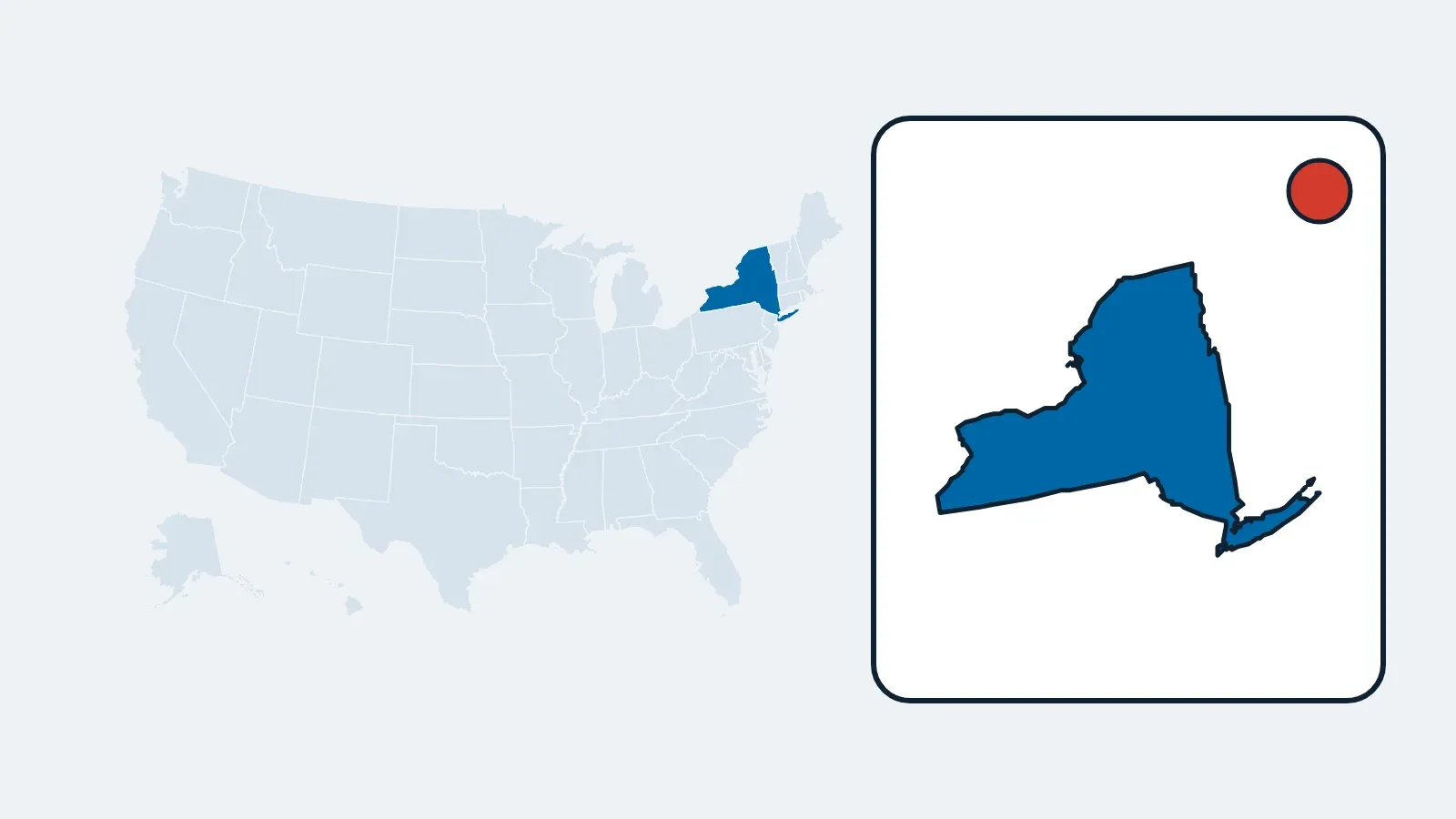
New York policy rules
State schedule- UM coverage rule
- Required
- Minimum liability
- 25/50/10 (50/100 for bodily injury when death results)Basic no-fault of $50,000 per person is also required
- UM/UIM rule
- UM required at 25/50; SUM optionalDFS says SUM is included unless you decline it in writing
- Insurer cancellation notice
- 20 days; 15 days for nonpaymentAfter 60 days, only nonpayment, license suspension or revocation, or fraud (Ins. Law §3425)
- Nonrenewal notice
- 45 to 60 daysNotice must state the specific reasons; nonrenewals capped at 2% per territory
- Regulator
- New York State Department of Financial Services
What every New York policy must include
The Department of Financial Services lists four required parts of a New York auto policy. They show up as separate lines on your declarations page:
| Coverage | Minimum | What it covers |
|---|---|---|
| Bodily injury liability | $25,000 per person, $50,000 per accident | Injuries you cause to others; $50,000 and $100,000 when death results |
| Property damage liability | $10,000 per accident | Damage you cause to others' property |
| No-fault (basic economic loss) | $50,000 per person | Medical bills, lost earnings and other economic losses |
| Uninsured motorist | Same bodily injury minimums as liability | Injuries caused by an uninsured driver in New York State |
A $10,000 property damage limit is low next to the price of many cars. The limits gap worksheet shows what a larger claim could leave on your side.
No-fault, UM and SUM
No-fault coverage pays you and your passengers for economic losses after a crash, whatever its cause, up to $50,000 per person. It works like the personal injury protection found in other states, and it comes on every policy.
Uninsured motorist coverage at the minimum limits is part of every policy as well, so New York appears as a required state on our map. What you choose is the optional layer: supplementary uninsured/underinsured motorist (SUM) coverage, which raises the protection and adds coverage when the at-fault driver's limits are too small. DFS says insurers include SUM by default unless you decline it in writing. See Part C for how the coverage reads.
When a New York insurer can cancel
Insurance Law §3425 governs cancellation of a personal auto policy. During its first 60 days, a new policy can be cancelled for any lawful reason, though the notice must state the specific reason. After that, and from the first day of a renewal, the insurer may cancel only for these reasons:
- Nonpayment of premium; the notice must state the amount due.
- Suspension or revocation, during the required policy period, of the driver's license of the named insured or of a regular driver of the car, with some exceptions.
- Fraud or a material misrepresentation in getting the policy or in presenting a claim.
Vehicle and Traffic Law §313 sets the notice. A cancellation can take effect no sooner than 20 days after the insurer mails the notice to the address in the policy, or 15 days when the reason is nonpayment. The insurer must mail it with a certificate of mailing from the postal service. Every termination notice also has to warn you that New York requires continuous proof of insurance for the whole time the car is registered.
Sometimes an insurer offers to keep the policy going on new terms instead of cancelling it. Under §3425(d)(2), that offer also needs written notice mailed at least 20 days before the change takes effect, so you have time to accept the terms or move your coverage elsewhere.
The required policy period for auto under §3425 is one year from the start or the last voluntary renewal. If you cancel your own policy, the refund depends on your policy's terms; the cancellation refund worksheet helps you estimate it.
Renewal and nonrenewal in New York
If an insurer will not renew, §3425(d)(1) requires written notice mailed or delivered at least 45 days and no more than 60 days before the policy period ends, with the specific reasons. The same window applies when an insurer offers to renew only with changed limits or with coverage removed, which the law calls a conditional renewal.
Insurers also face a cap: under §3425(f), nonrenewals and conditional renewals are generally limited to 2% of eligible policies per rating territory each calendar year. DFS adds that an insurer may not refuse to renew only because you have turned 60.
- Check the dates. A notice that arrives fewer than 45 days before the end of the term does not meet the rule.
- Ask the insurer to explain the reason if the notice is unclear.
- Contact DFS through its contact page at dfs.ny.gov if the reason or the timing looks wrong.
- Arrange new coverage before the end date. See lapse and reinstatement.
Policyholder questions
Can I turn down uninsured motorist coverage in New York?
Not the basic coverage at the minimum limits; it is required on every policy. You can decline the optional SUM coverage in writing. See Part C.
Can a New York insurer cancel me in the middle of the term after an accident?
Not once a new policy has been in force 60 days: the reasons are limited to nonpayment, a suspended or revoked license, and fraud or material misrepresentation. An accident record can matter at renewal, with 45 to 60 days' notice.
What does New York no-fault coverage pay?
Basic no-fault pays economic losses such as medical bills and lost earnings, up to $50,000 per person, regardless of who caused the crash. See personal injury protection.
Sources
- New York Insurance Law §3425 — Cancellation and nonrenewal of covered policies
- New York Vehicle and Traffic Law §313 — Termination of insurance
- New York State Department of Financial Services — Auto insurance
- New York State Department of Financial Services — Automobile insurance FAQs
Facts on this page were checked against these sources on November 15, 2026. The required coverages and the SUM default come from DFS's consumer page; we did not open Insurance Law §3420 separately.
Request policy quotes
Answer six questions about the policy you need. PolicyBrook passes the request to licensed insurance agents and insurers who can quote it; you compare and decide.
- The policy you need. Cars, drivers, coverage and ZIP.
- Your contact details and consent to be contacted.
- A licensed insurance agent or insurer contacts you with a quote. Nothing is bound until you sign and pay.
PolicyBrook is not paid by you. The licensed insurance agents and insurers who contact you set their own prices and terms. How we make money.
Related readings
-

Policy event
Insurer cancellation
After 60 days, only listed reasons; 10 to 60 days' notice by state, and how to appeal.
-
Policy event
Nonrenewal
Notice periods from 15 to 75 days, reasons states bar, and how to ask the regulator for review.
-
Policy part
Uninsured motorists (Part C)
Four kinds of uninsured vehicle, who is insured, limits, 60-day trial right after arbitration, state rules.